

Short version: Lead aggregators rent you demand. That can pay off when you are testing a new market or service, filling a slow stretch, or waiting for your own marketing to ramp up, but only if you call fast and track every lead to an appointment. Run them like a test with a budget and kill rules, judge them on cost per appointment and cost per closed job, and build the channels you own alongside them.
Plain definitions, because these terms get used loosely
- Lead aggregator: a marketplace that collects homeowner requests online and sells them to contractors, usually per lead.
- Shared lead: a request sold to more than one company. Exclusive lead: a request sold to one company only, at least for a set window.
- Converted lead: a lead that turned into an appointment.
- Cost per appointment: what you spent on a source divided by the appointments it produced.
- Cost per closed job: a separate metric. What you spent on a source divided by the jobs that actually closed.
The pitch is simple. Pay for leads, get calls, skip the slow grind of SEO and reviews. Some contractors build real volume this way. Others spend a year paying for phone numbers that never pick up.
The difference is rarely the platform. It is how the company buys, answers and measures. Here is when buying leads makes sense, where it quietly bleeds money, and how to run it so the math works for you instead of against you.
An aggregator rents you demand. It does not build any.
Here is the basic model. A homeowner fills out a form on a marketplace site. The marketplace matches the request to contractors who cover that service and ZIP code. Each matched contractor pays for the lead, whether or not they win the job.
Two details matter more than the sales pitch:
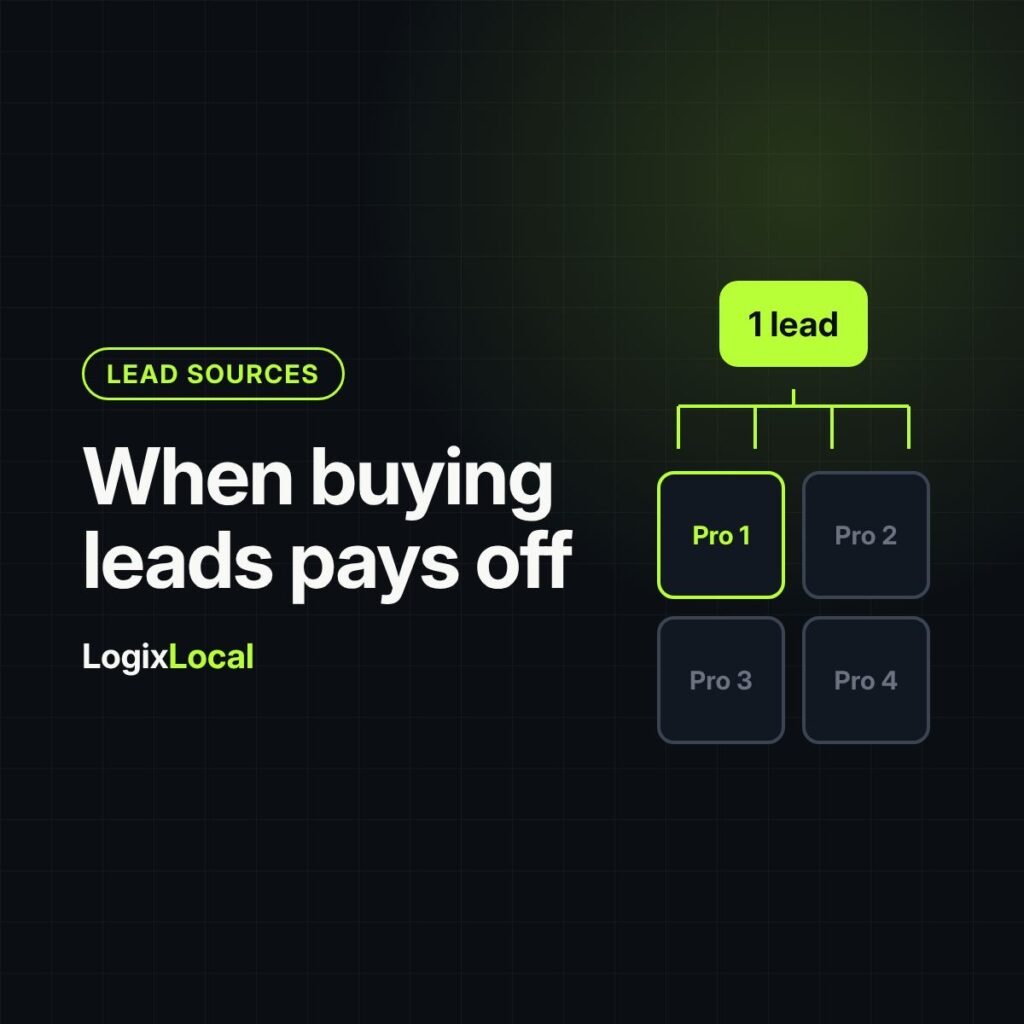
- You are often not the only one called. Angi’s help pages, for example, say a Market Match lead can go to up to four pros. Other lead types go to as many pros as the homeowner chooses to contact.
- You pay for the lead, not the outcome. The same help pages say you are charged for those leads whether or not you open or respond to them.
Neither of those is a scandal. It is how the product works. But it means you are buying a chance to compete, not a customer. And when you stop paying, the leads stop. Nothing you bought keeps working for you next month.
When buying leads pays off
Aggregators earn their place in a few specific situations. In each one, speed matters more than ownership.
- Testing a new market. You want to know if there is demand in a new county before you open a location or build service area pages. A few months of paid leads is a cheap way to find out.
- Testing a new service line. You added gutters, or water heaters, or attic insulation. Leads tell you whether homeowners will call you for it, and at what price.
- Filling a slow stretch. Crews are idle in the shoulder season. A lead that costs a bit more than usual can still beat paying a crew to sit.
- Bridging while your own marketing ramps. A newer company with a thin Google Business Profile and few reviews can use leads to keep the phone ringing while those build.
- High-ticket work. When one closed job covers dozens of leads, a lower close rate can still pencil out. A roof replacement has more room for waste than a drain cleaning.
Notice what all five have in common. Each is a bounded situation with an end date, not a permanent plan.
Where it quietly costs you
The dashboard counts leads. It does not count jobs. That is the quiet part nobody puts in the sales deck, and it is where the money goes.
- You compete on speed and price. When four companies call the same homeowner, the first one to reach them has the edge, and the cheapest quote often wins the rest. That pulls your average ticket down.
- Your team’s time is not free. Every dead number, duplicate and tire kicker takes call-center time. Every run appointment that goes nowhere takes a salesperson’s afternoon.
- Budgets creep. Lead volume feels like progress. Spend goes up a little each month, and nobody checks whether appointments went up with it.
- You build their brand, not yours. The homeowner found the marketplace, not you. Next year, they go back to the marketplace.
Buying leads to fill a gap is fine. Building the whole business on them is like renting a house forever because the first month was cheap.
On a shared lead, speed picks the winner
If several companies get the same request, the first one to have a real conversation usually wins. Think of the 90s radio call-in contests: being the ninth caller won the prize, and caller number ten got a busy signal.

The research backs this up, with a caveat. A Harvard Business Review study published in 2011 looked at 1.25 million sales leads across 42 US companies. Firms that tried to contact a lead within an hour were nearly seven times as likely to qualify it as firms that tried even an hour later. They were more than 60 times as likely as firms that waited 24 hours or more. The same study audited 2,241 companies and found the average first response took 42 hours, and 23% never responded at all.
That study is not about home services, and it is more than a decade old. But the direction is hard to argue with. A shared lead that waits until the morning is a lead someone else already booked.
What fast looks like in practice:
- Call within five minutes during business hours. Route new leads straight to whoever answers the phone, not to an inbox.
- Text right after the call if nobody picks up: your name, the company, and a simple question about the project.
- Try more than once, on more than one day. Many homeowners answer on the second or third try.
- Cover after-hours leads with an answering service or an automated text that books a callback time.
Win the first 60 seconds with a script, not a vibe
Fast is half of it. The other half is what you say when they pick up. Homeowners on a shared lead may have just heard from two other companies, so the call that sounds organized wins.
A first call that works:
- Name the request. “Hi, this is Dana with Example Roofing. You asked about a roof inspection on Maple Street a few minutes ago.”
- Ask one question about the problem. “Is anything leaking right now, or are you planning ahead?”
- Offer two times. “I can have someone there tomorrow at 10 or Thursday at 3. Which works better?”
- Confirm by text. Date, time, who is coming, and a number to reach you.
If nobody answers, send a text right away:
Hi, this is Dana with Example Roofing about your roof inspection request. We have openings tomorrow and Thursday. Want me to hold one for you?
Short, specific and easy to answer with one word. Skip the paragraph about your family history and your 47 five-star reviews. They can find that later. Right now they want to know when you can come.
Protect your price, or the lead protects someone else’s
Shared leads attract comparison shopping. That is not a flaw in the homeowner. Getting three quotes is smart. But it means the lowest bid has a head start unless you give a reason to pay more.
- Show up first. The first company in the door sets the frame for every quote that follows.
- Diagnose before you price. Photos, measurements and a plain explanation of the problem build trust that a number alone does not.
- Offer options. A good, better and best quote lets the homeowner choose instead of comparing your one number to someone else’s.
- Follow up on open quotes. Many jobs are won on the second or third follow-up, not the first visit.
If your average ticket on marketplace jobs is much lower than on your other sources, that belongs in the math too. A closed job that barely covers its own marketing is just a very busy way to break even.
The math: judge it by appointments and closed jobs
These numbers are made up to show the method. They are not benchmarks, so swap in your own.
Say you buy 40 leads in a month at $65 each. That is $2,600. Here is the same month with slow follow-up and with fast follow-up.
| Slow follow-up | Fast follow-up | |
|---|---|---|
| Leads bought (illustrative) | 40 | 40 |
| Total spend | $2,600 | $2,600 |
| Appointments (illustrative) | 10 | 16 |
| Cost per appointment | $260 | $163 |
| Closed jobs (illustrative) | 3 | 5 |
| Cost per closed job | $867 | $520 |
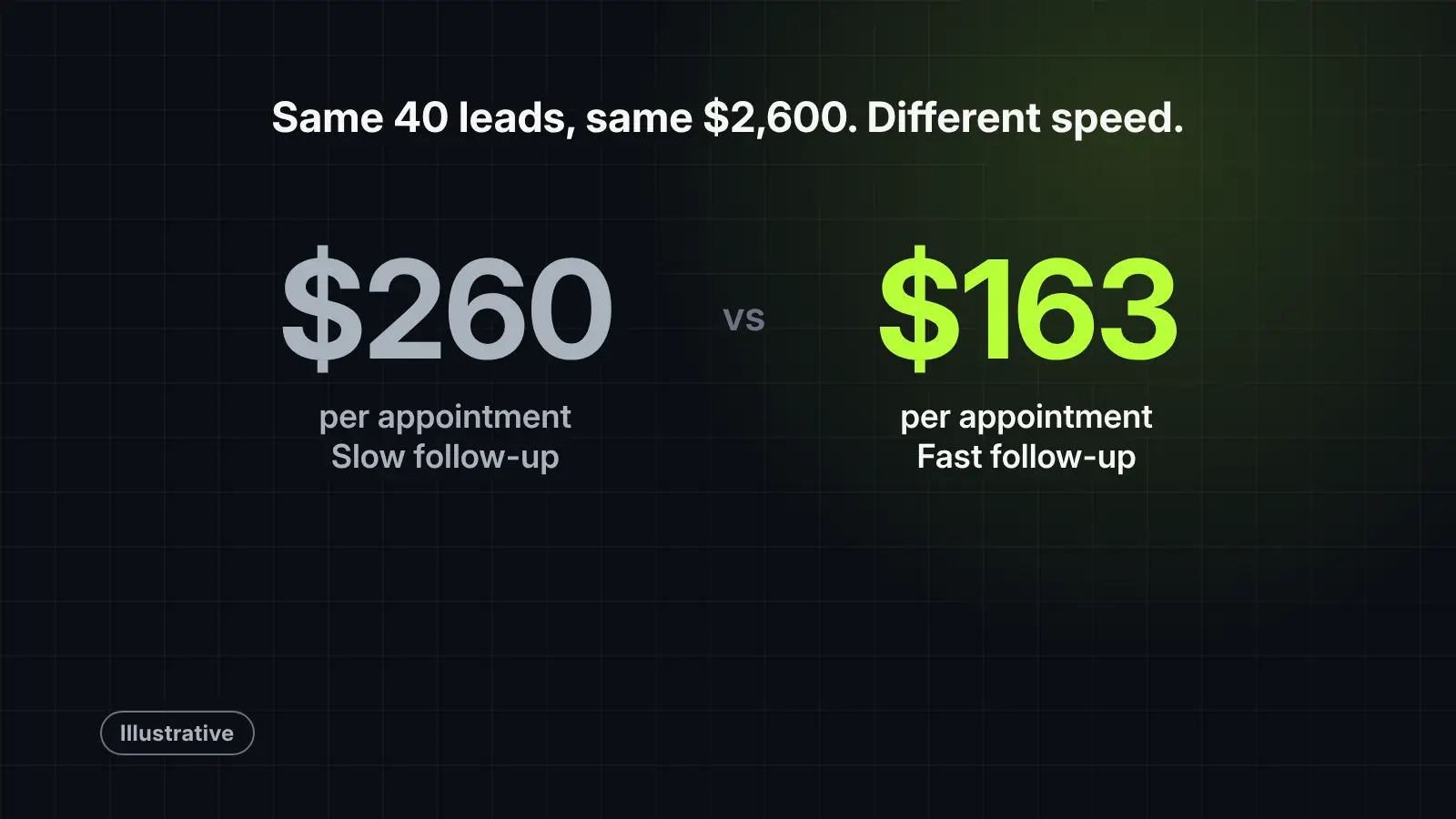
Same leads, same price. The only change is how fast someone picked up the phone, and the cost per closed job dropped by about 40%.
That is why “this source doesn’t work” is often the wrong conclusion. Sometimes the source is fine and the follow-up is the problem. You can only tell the difference if you track both.
To decide whether the source is worth keeping, compare cost per closed job against what a closed job is worth to you. If your average job brings in enough gross profit to cover $520 of marketing with room to spare, that source is working. If it doesn’t, no amount of volume will fix it.
Run it like a test, not a subscription
Before you turn a lead source on, write down the rules you will judge it by. It takes ten minutes and saves months of drift.
- Set a budget and a time limit. For example, a fixed amount per month for 90 days.
- Set your kill number. The cost per appointment, and later the cost per closed job, above which you stop.
- Tag the source on every lead. In your CRM, every lead from the marketplace gets the same source value, every time.
- Record an outcome on every lead within 24 hours. Booked, not reached, wrong number, duplicate, out of area, wrong service, not interested.
- Request credits for bad leads. Most platforms credit some invalid leads, inside a time window. Do it weekly so it does not pile up.
- Review monthly. Leads, appointments, closed jobs and cost per closed job, side by side with your other sources.
If the test passes, keep going and keep measuring. If it fails, stop. Don’t keep paying because the phone feels busy.
More in Lead Sources: Exclusive vs. shared leads: what you are really buying, and how to dispute bad ones.
Build the channels you own alongside it
The best use of paid leads is to buy time while you build the things that keep working when you stop paying.
- Your Google Business Profile and reviews. These drive calls from the map results, and they compound.
- Local Services Ads. You still pay per lead, but the leads come to you, not to a list of competitors.
- Your website and local SEO. Slower to build, but nobody else gets your organic calls.
- Past customers and referrals. The cheapest appointments most companies have, and the most neglected.
As those grow, lead spend should shrink or stay flat. If it keeps growing instead, the business is getting more dependent on it, not less.

Field note
Lead aggregators can be a lifesaver for plugging holes in your schedule when you need to keep crews busy during slow stretches, but they shouldn’t run on autopilot year-round. Keep a close eye on your backlog: the moment your owned channels and local map rankings are keeping the books full, pause or dial back those paid marketplaces. Just remember that these aggregator sources inherently carry lower closing rates, so managing them tightly and knowing when to turn off the tap is what separates a smart stopgap from a margin killer.
What we would check first in your account
- How much you spent on lead marketplaces in the last 90 days, and how many appointments and closed jobs came from it.
- Whether every marketplace lead has a source tag and an outcome in your CRM.
- How long it takes, on average, from a new lead to the first call attempt.
- Whether anyone requests credits for bad leads, and how much was credited last quarter.
- How cost per closed job from marketplaces compares with your other sources.
Want help sorting this out? See our lead aggregator and lead generation work.


