

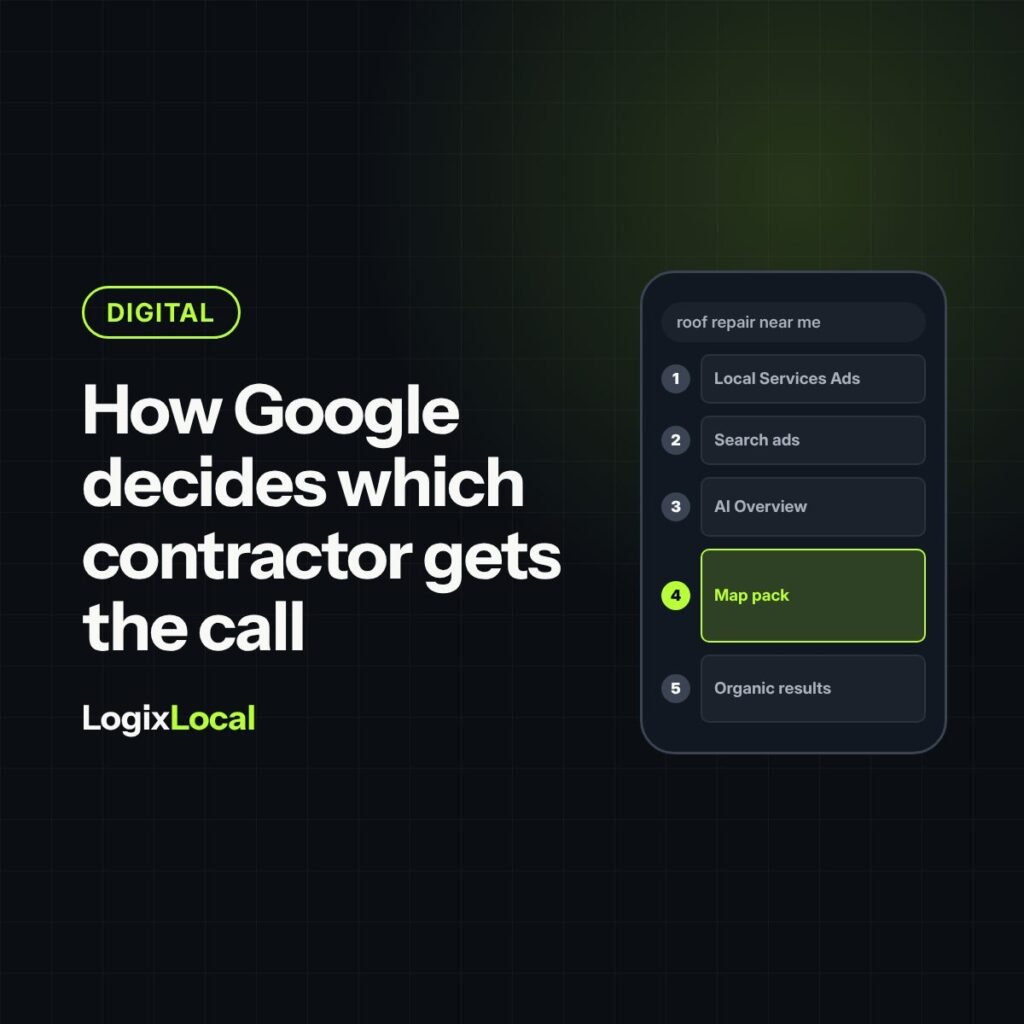
Short version: A phone results page for “roof repair near me” holds five different races: Local Services Ads, Search ads, AI answers, the map pack and the regular results. Each is won a different way, and most contractor websites are built to win one of them. Know which layers your customers see, earn the map pack town by town, run your Business Profile like a sales page, build service-area pages that only a local company could write, and make the website easy to call from a phone.
Plain definitions
- Map pack: the map and short list of local businesses Google shows for searches like “plumber near me.”
- Google Business Profile: your free listing on Google Search and Maps, with your categories, hours, photos and reviews.
- Organic results: the regular, unpaid list of websites below the ads and the map.
- AI Overview: the AI-written summary Google shows at the top of some results.
- Doorway page: a page made to rank for a search, usually a city name, without offering anything useful of its own.
- Converted lead: a lead that turned into an appointment.
A phone results page is a 1996 TV Guide grid: five channels on one screen, each with its own schedule and its own rules. You can own one channel and be off the air on the other four.
That’s why “we rank on Google” and “the phone doesn’t ring” are both true for so many contractors.
Five races on one page
Read the page top to bottom the way a homeowner does. The first two layers are paid. The last three are earned.
| Layer | How you pay | What wins it |
|---|---|---|
| Local Services Ads | Per lead | Your bid, reviews, how fast you answer, a complete and verified profile |
| Search ads | Per click | Your bid, how well the ad fits the search, the page the click lands on |
| AI Overview | Earned | Clear, specific pages that answer the question outright |
| Map pack | Earned | Relevance, distance and prominence on your Business Profile |
| Organic results | Earned | Pages built around the job, links from real sites, a fast site |
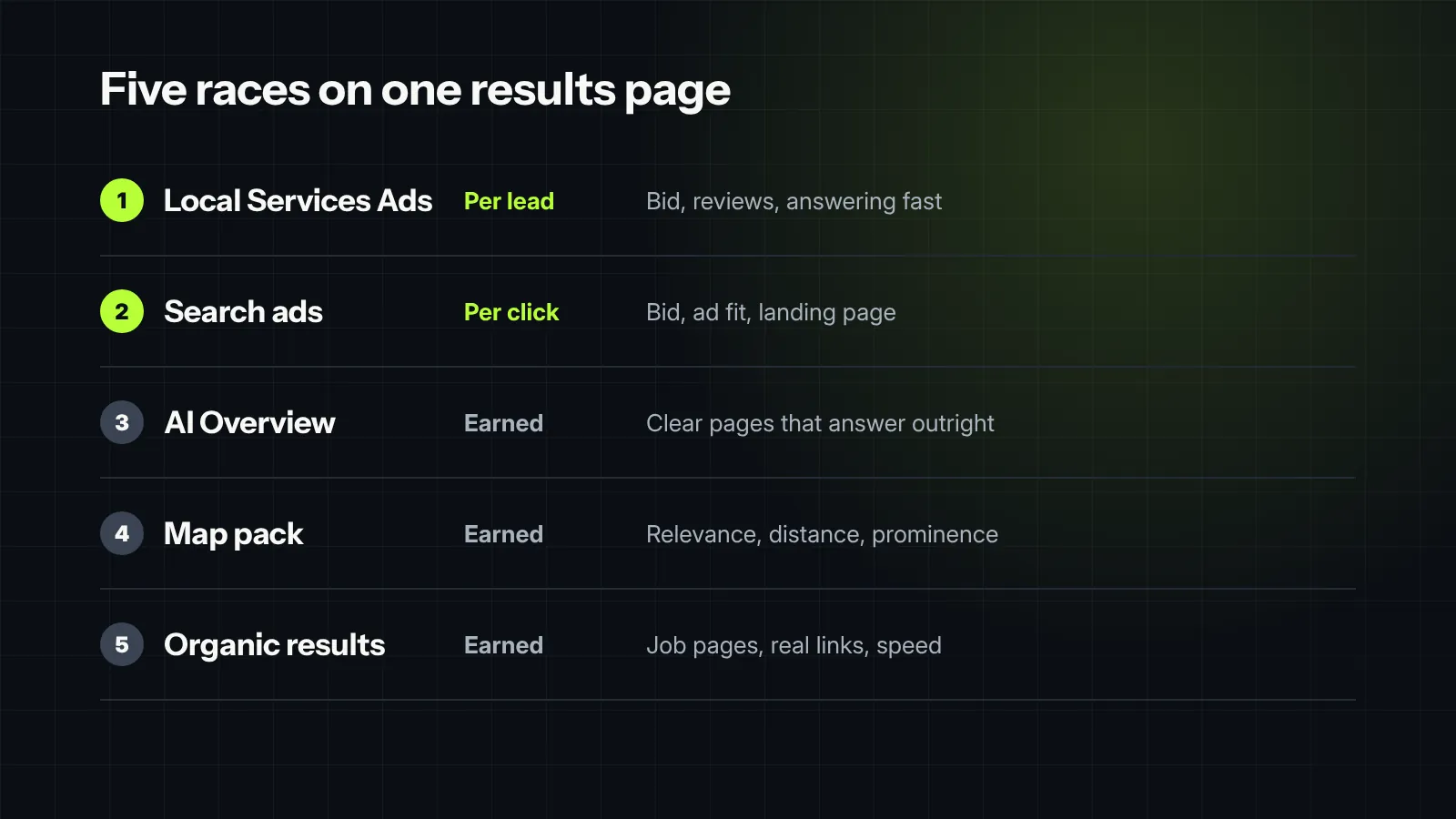
The practical point: a website project, an SEO retainer and an ad budget each touch only some of these layers. Before you spend on any of them, know which layers your customers actually see for your trade, and which ones you’re missing.
The map pack is a radius game
Google’s help page on how local ranking works names three things: relevance, distance and prominence.
- Relevance: how well your profile matches the search. You control most of it.
- Distance: how far your business is from the person searching. You can’t move it.
- Prominence: how well known you are. Google points to reviews and links from other websites. It’s earned over time.
Distance is the one owners underestimate. The same company can rank first in the map pack near its office and disappear a few miles out, because every search starts from where the homeowner is standing.
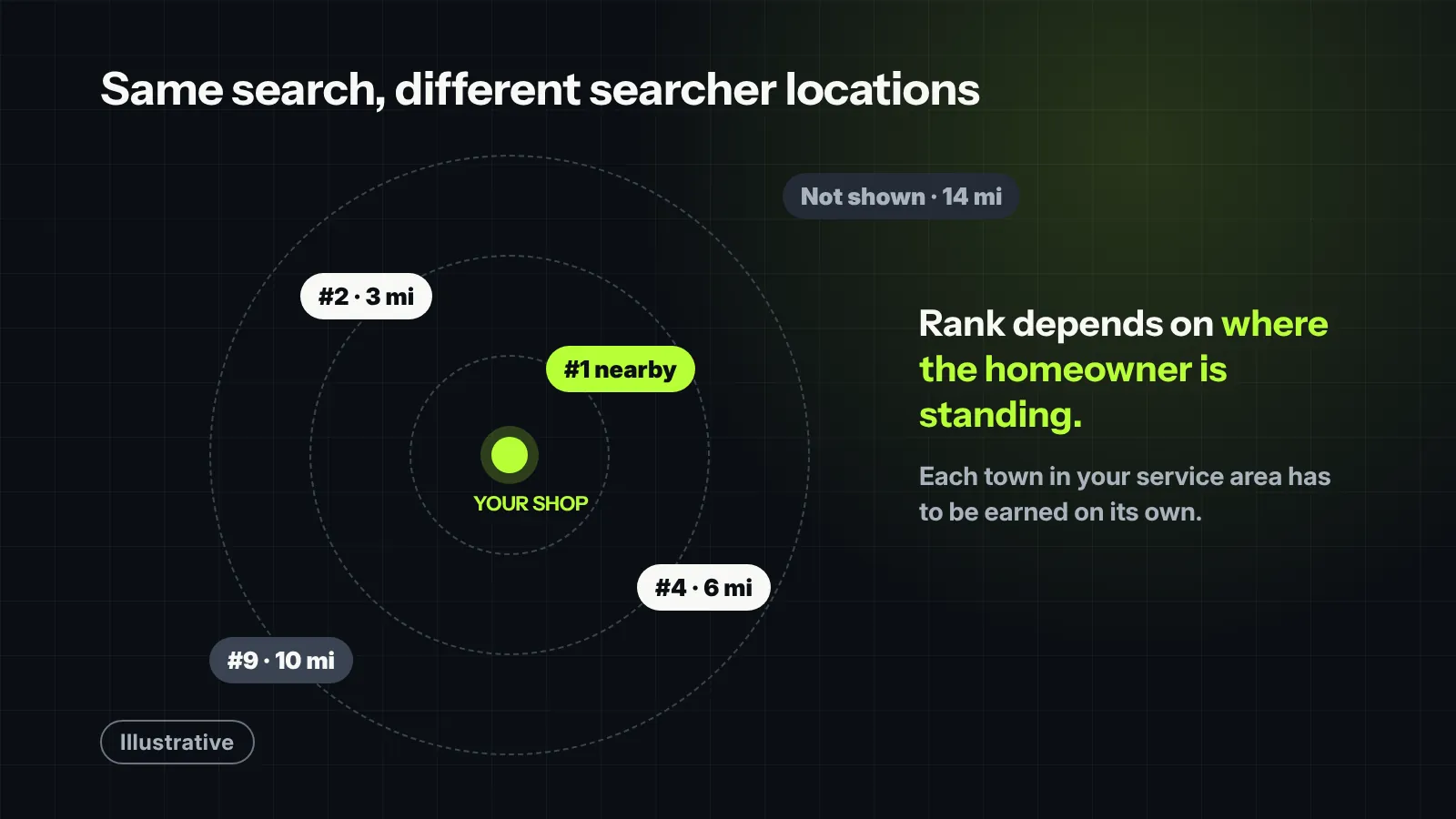
Check your own rank from several spots across your service area, not just from your desk. A service area that covers several towns has to earn each town on its own.
Run your Business Profile like a sales page
Your Business Profile is your map pack entry. Treat it like a sales page, not a phone book listing.
- Primary category first. It does most of the relevance work, so name the job you most want, not the broadest thing you do.
- Secondary categories and services. List every job type you sell. If it isn’t on the profile, don’t expect to show up for it.
- Real photos, added often. Jobs you finished, your trucks, your crew. Not stock images.
- A steady flow of reviews. Google says more reviews and positive ratings can help local ranking. Ask after every finished job, and reply to each review.
- Accurate hours and service area. Wrong hours send calls to a closed office.
Reviews are a faucet, not a bucket. A one-time push fills it once, and it drains.
Service-area pages that aren’t doorway pages
To show up in the next town, you need a page about that town. But a page that only swaps in a new city name is a doorway page, and Google’s spam policies treat those as spam.
The test is simple: could only someone who works there have written this page?
| Doorway page | Real service-area page | |
|---|---|---|
| Copy | Template with the city swapped | Written for that town’s homes and problems |
| Photos | Stock images | Jobs finished in that town |
| Reviews | The same sitewide widget | Reviews from customers there |
| Local detail | None | Housing age, soil, weather, permits |
| Links | A footer list of 40 cities | Linked from the matching service pages |
| Purpose | Catch a keyword | Help a homeowner there decide |
Start with the towns where you already have jobs, photos and reviews. Ten real pages beat a hundred thin ones.
The website has to make calling easy
Every layer above sends people to the same place: your site, on a phone, often while standing in a driveway or a wet basement. Ranking is wasted if that page makes calling hard. Tap what your site already has:
- A tap-to-call button visible without scrolling
- A tracking number that changes by traffic source
- A form with five fields or fewer
- Financing mentioned near the top
- Reviews or your rating next to the call button
- Real job photos, not stock
- A page that loads fast on a phone
- Your service area stated plainly
Fix the first three before anything else. They decide whether a visit becomes a call. The tracking number is what tells you which source sent each call; see call tracking for contractors.

Field note
Most home service search traffic arrives on a mobile screen, yet most contractor sites are still designed for a desktop monitor. We reviewed a site that had great local rankings but terrible lead conversion. When we went through a mobile audit checklist, the issue was immediately obvious: sticky click-to-call buttons were overlapping contact forms, tap targets were too small for a thumb, and the hero section forced users to scroll past three giant images just to find a phone number. Fixing those basic mobile layout hurdles immediately boosted their call volume without adding a dollar to their ad spend.
AI answers: the new top of the page
AI Overviews and other AI answer tools now sit above many local searches. They summarize pages that state facts plainly: what you do, where, for whom, and what it involves. Vague, keyword-stuffed pages give them nothing to quote.
The same work that helps a homeowner decide also gives these tools a clean answer to use. Every service page should carry:
- One clear headline that names the service and the area.
- A plain answer to “what does this cost and how long does it take,” even as a range.
- Real questions and answers, taken from what your CSRs hear on the phone.
- Details that match your Business Profile: the same name, services, area and hours.
- Proof a person can check: licenses, warranty terms, photos from named projects.
One note on FAQ markup: Google stopped showing FAQ rich results in May 2026. Keep the questions on the page, because people and AI tools still read them, but don’t expect the old dropdowns in search results.
A 90-day plan
For a single-location company, this is the order we would work in. Each phase sets up the next: a clean profile helps new pages rank, and new pages give reviews and links somewhere to point.
| Weeks | Focus | Work |
|---|---|---|
| 1 to 4 | Foundation | Profile categories and services, call and form tracking, speed and mobile fixes |
| 5 to 8 | Pages and reviews | Service pages by job type, the first service-area pages, a review request after every job |
| 9 to 13 | Authority | Local links and partnerships, answers to common questions, then measure and add towns |
Judge it on calls and converted leads by source, not on rankings alone. The scoreboard is in the five numbers an owner should see every month.
What we would check first in your account
- Your map rank from several points across your service area, not just at your office.
- Your Business Profile categories and services, compared with the jobs you most want.
- Your service-area pages: real local proof, or a swapped city name.
- Whether calls from search are tracked by source and reach your CRM.
- How easy it is to call you from your website on a phone.
Want help with this? See our local SEO, Google Business Profile and website design work.


