

Short version: Call tracking exists to answer one question: which marketing made the phone ring, and did that call turn into a job? Track the source, first-time callers, missed calls and the outcome of every call. Ignore total call counts and average call length on their own. Set up your numbers so they don’t scramble your Google listing, and push every call’s source into your CRM so it follows the lead all the way to a closed job.
Plain definitions
- Call tracking: using separate phone numbers for different marketing sources, so you can see which source each call came from.
- Tracking number: a number that forwards to your main line and records where the call came from.
- Dynamic number insertion (DNI): a script on your website that swaps in a different tracking number depending on how the visitor arrived, such as from a Google ad or a Facebook post.
- First-time caller: a number that has never called you before. A good stand-in for a new customer.
- Converted lead: a lead that turned into an appointment.
In the 90s, attribution in most shops was an answering machine and a receptionist asking “how’d you hear about us?” Half the time the answer was “the phone book.” The other half was “I don’t remember.”
Call tracking fixed the guessing. Then a lot of companies buried themselves in call reports nobody reads. Here is what is worth tracking, what to ignore, and how to set it up without breaking anything.
Call tracking answers one question
Which marketing made the phone ring, and was it worth it? Every number in a call report should help answer that. If it doesn’t, it is decoration.
For a home-service company, the phone is still where most jobs start. If you can’t tie calls to a source, you can’t tell your best channel from your worst. You end up cutting the wrong budget.
Track these six things
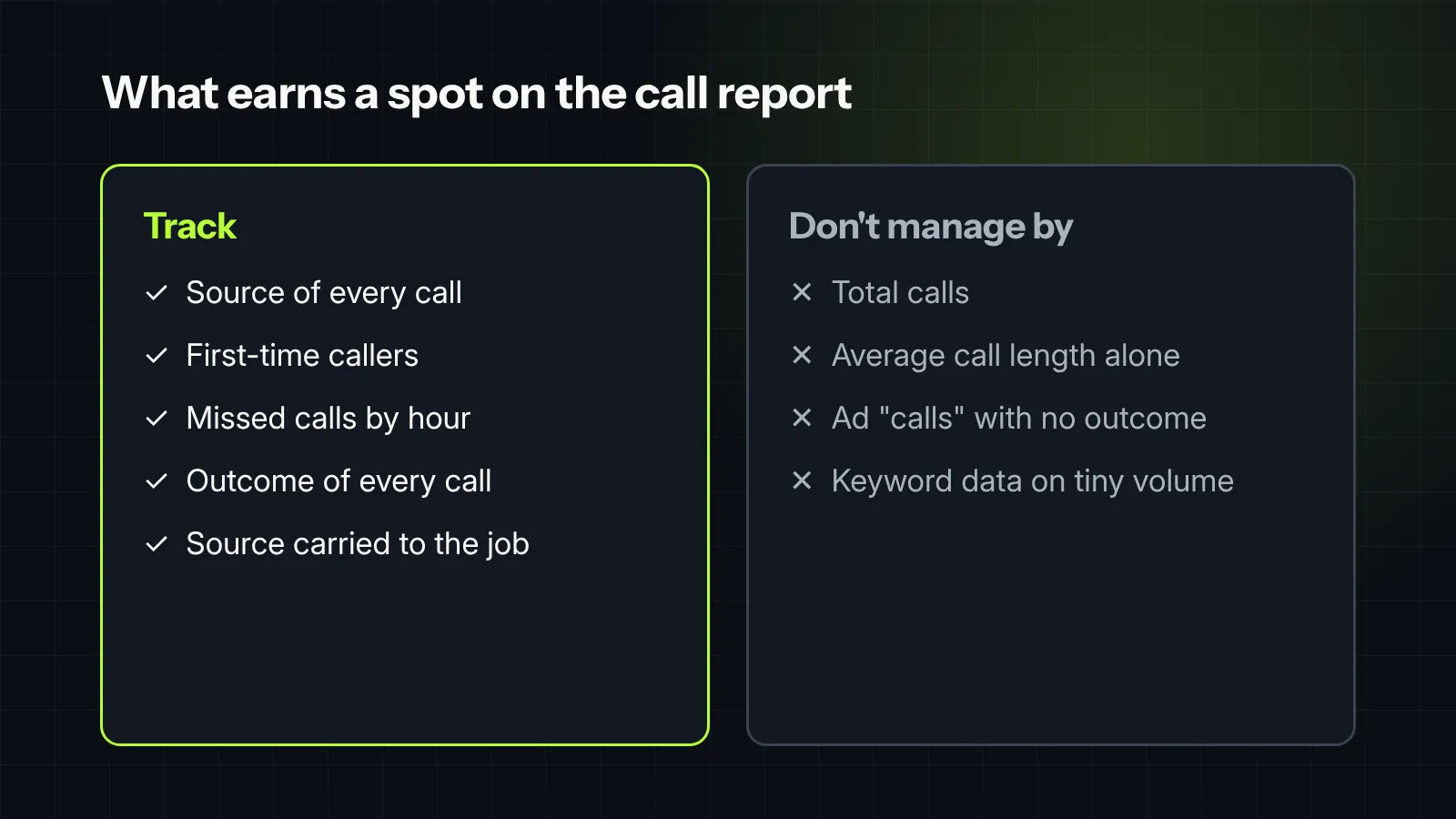
- Source of every call. One number per offline channel, such as each mailer, truck wrap or radio spot, and dynamic numbers on the website for each online source.
- First-time callers. New customers are what your marketing is paying for. Repeat callers and existing customers should not count as new leads.
- Answered vs. missed calls. By hour and by day of the week. This is usually the most expensive line on the report.
- Outcome of every call. Booked, not booked, existing customer, vendor, spam or wrong number. Your team tags it, or a tool does it from the recording.
- Recordings of booking calls. Not to listen to all of them. To spot-check the ones that didn’t book and coach from real examples.
- Source carried into the CRM. The call’s source should follow the lead to the appointment and the closed job.
How dynamic numbers actually work, and what they miss
Dynamic number insertion runs a small script on your website. When someone arrives, the script checks how they got there, such as a Google ad, organic search or a Facebook post. It then shows that visitor a phone number tied to that source.
A few details decide whether it works well:
- Source-level or visitor-level. Source-level gives every visitor from Google Ads the same number. Visitor-level gives each visitor their own number from a pool, so a call can be tied to the exact page, ad and keyword. Visitor-level needs more numbers and costs more.
- Pool size. With visitor-level tracking, you need enough numbers to cover the visitors on your site at the same time. Too few and numbers get reused, which muddies the data. Your call tracking vendor can size it from your traffic.
- Every page. The script has to load on every page, including landing pages built outside your main site.
Dynamic numbers can’t see everything. Someone who saw your truck, then looked you up and called the number on your Google listing, shows up as a Business Profile call. Someone who saved your number from last year shows up as direct. That is normal. Tracking is the floor, not the whole picture, so ask “how did you hear about us?” too.
Tag call outcomes without adding a second job
Source tells you where a call came from. Outcome tells you whether it was worth anything. You need both.
| Outcome code | What it means |
|---|---|
| Booked | A new customer set an appointment. |
| Not booked: price | Asked for a price and didn’t book. |
| Not booked: timing | Couldn’t get a time that worked, or is planning ahead. |
| Not booked: service | Needed something you don’t do, or is outside your area. |
| Existing customer | Warranty, scheduling or billing call. |
| Not a lead | Vendor, job seeker, spam or wrong number. |
Keep the list short and fixed. Your call takers pick one at the end of every call, or your call tracking tool tags it from the recording. Many tools can now score calls automatically. Spot-check that scoring before you trust it.
Ignore these, or at least don’t manage by them
- Total calls. It mixes new customers, existing customers, vendors and robocalls. Going up can mean nothing.
- Average call length on its own. A long call can be a booked job or a 12-minute complaint. Short calls can be quick bookings.
- “Calls” counted as conversions in your ad platform with no outcome attached. Ad platforms count calls longer than a minimum length you set. That is a signal, not a booked job.
- Keyword-level call data for small accounts. With a handful of calls per keyword, the numbers swing on luck. Look at campaigns and sources first.
None of these are useless to a marketer tuning a campaign. They just shouldn’t be the numbers an owner uses to decide where the money goes.
Set up your numbers without scrambling your listings
Bad number setup is the most common way call tracking backfires. Here is a setup that works for most companies.
- Offline: one tracking number per channel or campaign. Each mail drop, each billboard, each truck wrap design.
- Website: dynamic numbers that swap based on the visitor’s source. Keep your main number in the page’s code, so search engines still see one consistent number.
- Google Business Profile: Google’s guidelines for representing your business say the phone number must be under the direct control of the business, and that additional numbers can be used. A common setup is a tracking number you own as the primary number, with your main line listed as an additional number.
- Directories and citations: keep your main number everywhere else, and keep it identical. Mixed numbers across directories make your business look like several businesses.
Own your tracking numbers. If you change vendors or agencies, you want to take the numbers with you, not lose the ones printed on every truck.
Texts and forms count too
Plenty of homeowners would rather text or fill out a form than call. If you only track calls, those leads disappear from your source reports.
- Make tracking numbers text-enabled. A text to a tracking number should show up with the same source as a call to it.
- Capture the source on web forms. Hidden form fields can record how the visitor arrived, such as the ad campaign or “organic search,” and pass it into your CRM with the lead.
- Keep chat and booking widgets in the same system. If a lead books online, it still needs a source.
The goal is one list of leads, from every channel, each with a source. Calls are just the biggest piece of it.
Missed calls are the most expensive line on the report
Most owners look at how many calls came in. Few look at how many nobody answered. That gap is often where the money goes.
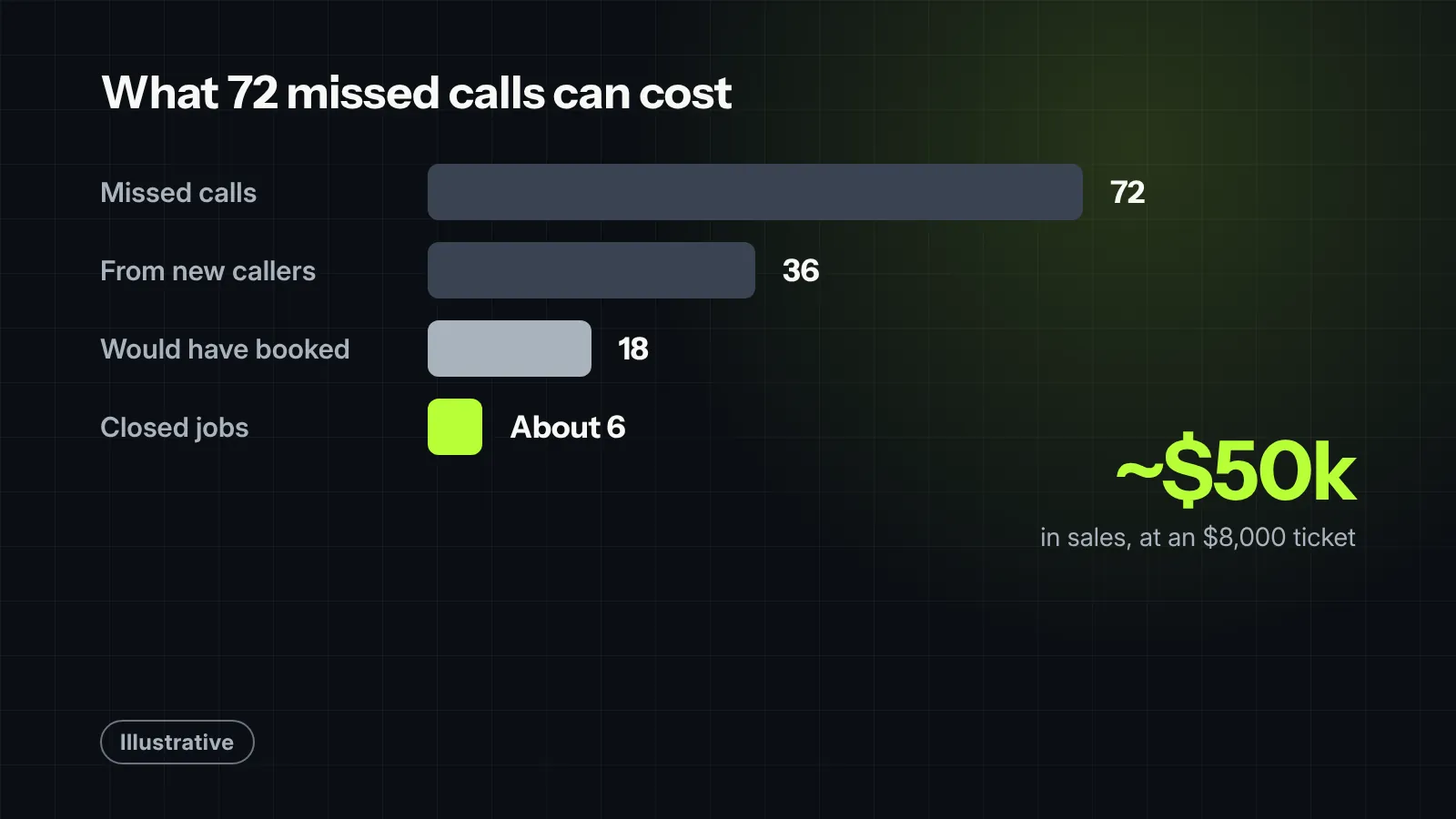
These numbers are made up to show the method. Swap in your own.
| Step | Illustrative number |
|---|---|
| Inbound calls in a month | 400 |
| Missed, at 18% | 72 |
| Missed calls from first-time callers, about half | 36 |
| Appointments they might have booked, at 50% | 18 |
| Closed jobs, at a 35% close rate | About 6 |
| Sales at an $8,000 average ticket | Roughly $50,000 |
Not every missed caller is lost. Some call back. But many call the next company on the list, and you paid to make that phone ring.
Look at missed calls by hour. If they pile up at lunch, early morning or after 5, that is a staffing or routing fix, not a marketing problem. A missed-call text-back catches some of the rest.
A 20-minute weekly call review
You don’t need to listen to every call. Once a week, pull five first-time calls that didn’t book and listen for four things:
- The greeting. Did the caller know they reached the right company, quickly?
- The question. Did your team ask about the problem before talking price?
- The ask. Did anyone actually offer an appointment time?
- The price question. When the caller asked “how much,” did they get a reason to book an inspection, or just a number?
Play one good call and one missed opportunity in your next team meeting. It is the cheapest sales training you will ever run.
Recordings: useful, with rules
Call recordings are the fastest way to find out why calls don’t book. You will hear it: the caller asked for a price and got put on hold, or nobody asked for the appointment.
Recording laws vary. Some states require every party on the call to agree to the recording. A short disclosure at the start of the call, such as “this call may be recorded for quality,” is standard practice. Have your attorney confirm what applies to you. This is not legal advice.
Connect calls to jobs, not just to ads
A call is not a customer. The real value of call tracking shows up when the call’s source follows the lead into your CRM, through the appointment, to the closed job.
- Send the source into the CRM automatically. Most call tracking tools can create or update a lead with the source attached.
- Tag the outcome. Booked or not, and why not.
- Send closed jobs back to your ad platforms. Then Google can optimize for calls that become jobs, not just calls that last a while.
Once that is in place, you can see cost per appointment and cost per closed job by source. That is the scoreboard that matters. More on that in the five numbers an owner should see every month.

Field note
Running call tracking isn’t just about counting inbound leads; it’s about listening to why people don’t book. On paper, one client had a solid volume of incoming calls, but their conversion rate was cratering. When we audited the call recordings, we expected to hear bad leads or pricing pushback. Instead, we found a simple staffing pattern: almost half of their unbooked calls were hitting the shop during the 11:30 AM to 1:00 PM lunch window when the front desk was down to a single person. Calls were going to voicemail or getting rushed off the phone. A minor shift in lunch rotations fixed a leak that months of marketing tweaks couldn’t touch.
What we would check first in your account
- Whether every marketing channel, online and offline, has its own tracking number.
- Whether your Google Business Profile number is a tracking number you own, with your main line listed as an additional number.
- Your missed-call rate by hour and day of the week.
- Whether first-time callers are separated from existing customers in your reports.
- Whether the call’s source reaches your CRM and stays on the lead through to the closed job.
Want help setting this up? See our call tracking work.


