

Short version: “Exclusive” means nobody else gets that lead for a set window. It says nothing about whether the lead is any good. Before you buy, ask how many companies get each lead, what counts as a lead, and what the credit policy covers. After you buy, give every lead an outcome within 24 hours, keep the proof, and dispute bad leads every week inside the platform’s window.
Plain definitions
- Exclusive lead: a homeowner request sold to one company only, at least for a set period.
- Shared lead: the same request sold to several companies at once.
- Invalid lead: a lead you should not have been charged for under the platform’s rules, such as a wrong number or a duplicate.
- Lead credit: money a platform puts back on your account for an invalid lead. It is usually a credit toward future leads, not cash back.
- Converted lead: a lead that turned into an appointment.
Lead sellers love the word “exclusive.” It sounds like quality. It isn’t. It is a promise about competition, and the difference matters when you are deciding what to pay.
Exclusive is about who else calls, not how good the lead is
An exclusive lead can still be a wrong number, a renter who can’t approve the work, or someone who wanted a price for a project five years out. A shared lead can be a homeowner with a leaking roof who books the first company that calls.
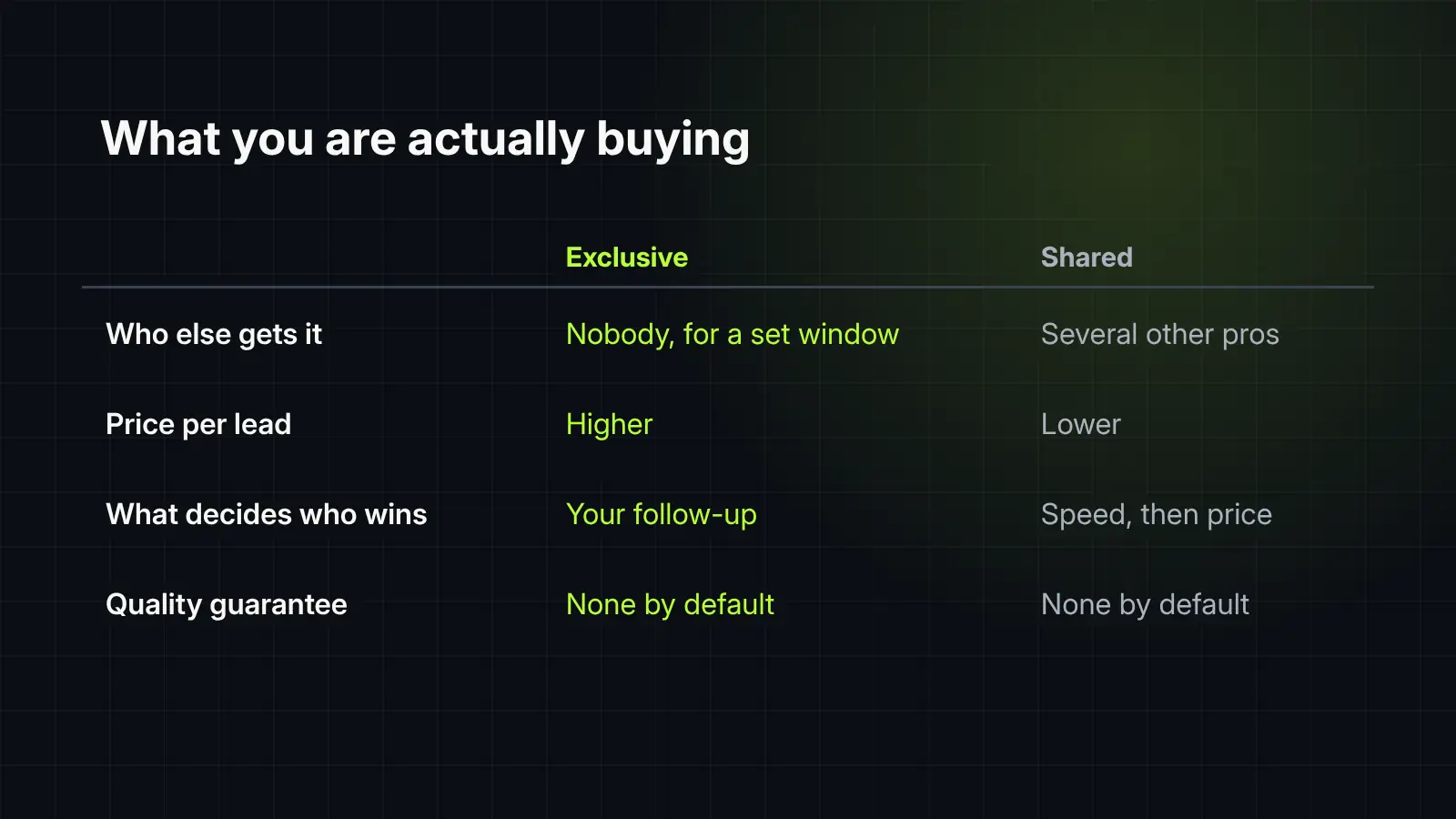
So you are not choosing between good and bad leads. You are choosing how many competitors you want on the phone with the same homeowner, and how much you will pay to have fewer.
Shared leads are cheaper because you are splitting them
Marketplaces are fairly open about this. Angi’s help pages, for example, say a Market Match lead can go to up to four pros. Other lead types go to as many pros as the homeowner chooses to contact.
A shared lead can still be a good buy. It just changes what wins. With four companies calling, the first to reach the homeowner has the edge, and price does a lot of the rest.
If your team calls within minutes and you are comfortable competing on price, shared leads can work. If your follow-up is slow or your price is premium, you are mostly paying to come in second.
A note on consent. A single web form can ask a homeowner to agree to calls from several companies at once. In 2023 the FCC adopted a rule that would have limited that consent to one company at a time, but a federal appeals court struck it down in January 2025 before it took effect, and the FCC later removed it.
The usual consent rules for calls and texts still apply. Ask the seller for proof of consent, and have your attorney review how you call and text marketplace leads. This is not legal advice.
Ask these questions before you buy
A sales rep will happily walk you through the dashboard. These are the questions that actually decide what you are paying for.
- How many companies get each lead? Get the number for each lead type, in writing.
- If it is exclusive, for how long? An hour, a day, forever? Some leads are resold later.
- What counts as a lead? A form? A call? If calls, how long does a call have to last before you are charged?
- Where do the leads come from? The seller’s own site, partner sites, or ads? The source tells you a lot about intent.
- Can you show proof of consent? A record of what the homeowner saw and agreed to, with a timestamp.
- What does the credit policy cover, and what is the window? Get the list of creditable reasons, and how many days you have to ask.
- Can you control service types, ZIP codes and budget? Every setting you can tighten is money you don’t waste.
What counts as a bad lead, and what doesn’t
This is where most disputes go wrong. Platforms credit leads that should never have reached you. They do not credit leads that reached you and didn’t work out.
| Usually creditable | Usually not creditable |
|---|---|
| Wrong or disconnected phone number | Homeowner never answered |
| Duplicate of a lead you already paid for | Homeowner picked another company |
| Outside the area you cover | Price shopper or “just looking” |
| A service you don’t offer | Appointment that didn’t close |
| Spam, or a competitor testing the system | Project planned for much later |
Every platform writes its own rules, so treat this table as a starting point, not a promise. Two real examples show how much they differ.
- Angi Leads (HomeAdvisor) lists duplicates, an incorrect ZIP code, the wrong project type, competitor testing and a wrong or disconnected phone number as reasons for credit. The lead must be at least 24 hours old and less than 30 days old when you ask. Its credit request page also asks you to confirm that call tracking is on, that you called within 24 hours, and that you tried on more than one day.
- Google Local Services Ads says leads judged invalid at first contact are not charged, and charged leads may be credited automatically later if they turn out to be low quality. Google says it no longer credits “job type not serviced” or “geo not serviced” leads, so those are fixed in your settings, not through a dispute. Google explains how it handles lead charges and credits in its Local Services Ads help.
Rules like these change. Check each platform’s help pages before you build your process around them.
How to dispute without it becoming a second job
Disputes fail for two reasons: nobody remembers which leads were bad, and the window closes before anyone asks. A small weekly routine fixes both.
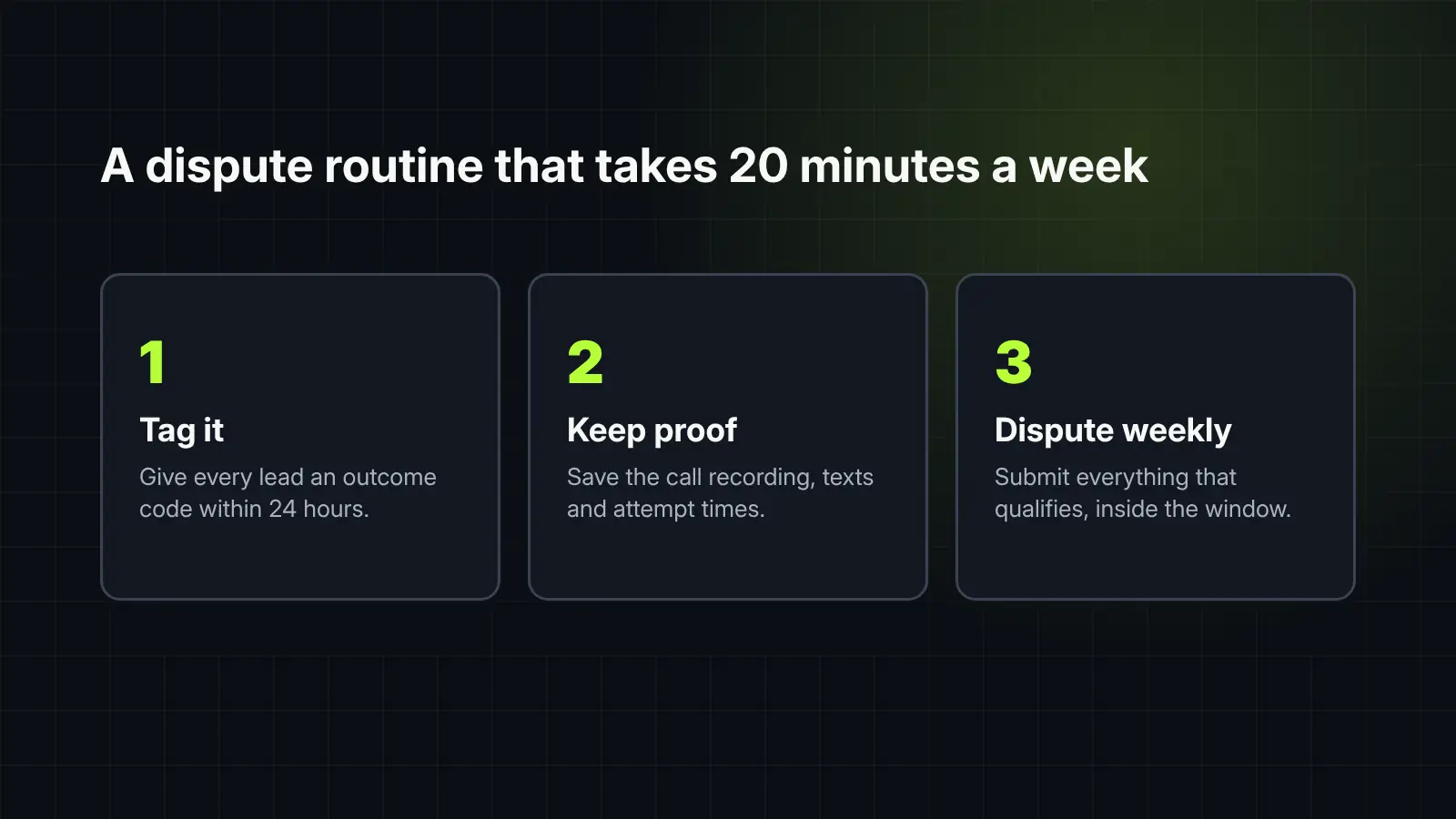
- Tag every lead with an outcome within 24 hours. Use a short, fixed list in your CRM: booked, not reached, wrong number, duplicate, out of area, wrong service, spam, not interested. Free text is where disputes go to die.
- Keep the proof. Call recordings, text history and the times of each attempt. Call tracking does most of this for you.
- Follow the platform’s contact rules. If the policy asks for a call within 24 hours and attempts on more than one day, do exactly that, or the credit gets denied.
- Dispute once a week. Pull every lead tagged with a creditable reason and submit them together, well inside the window.
- Fix the settings that caused it. If you keep getting out-of-area or wrong-service leads, tighten your ZIP codes and service list. A credit refunds one lead; a setting stops the next fifty.
- Track your credit rate. Credits received divided by leads bought, per source, per month. If it climbs, the source is getting worse.
Keeping up with this is like rewinding a rented tape before you return it to the video store. Skip it and the late fees pile up quietly until you get the bill.
Exclusive or shared? A simple way to decide
- Lean shared if your team calls within minutes, your prices are competitive, and you want volume at a lower price per lead.
- Lean exclusive if your follow-up is slower, your price is premium, or your sales process needs time with the homeowner.
- Either way, judge it on cost per appointment and cost per closed job, not price per lead. A $30 shared lead that never books is more expensive than a $90 exclusive lead that does.
More in Lead Sources: Lead aggregators: when buying leads pays off and when it does not.

Field note
If you’re buying shared leads, you aren’t just competing on price, you’re racing a clock.
A lot of home service businesses make the mistake of routing shared marketplace leads to an in-house call team that handles regular inbound traffic. If you expect your staff to manually pick those up and dial faster than the three other companies who bought the same lead, you’re going to lose that race almost every time.
That’s why operations working heavy shared volume use automated speed-to-lead platforms (like Lightfire) that integrate directly with lead sources and dialers. The moment a lead hits the board, it triggers a callback within seconds: long before a human could even open the ticket. If your tech stack can’t win the speed race, buying shared leads usually just means you’re paying to fund your competitors’ conversions.
What we would check first in your account
- How many companies receive each type of lead you are buying, according to the seller’s own documentation.
- Whether every lead gets an outcome code in your CRM, and how many sit blank.
- Whether anyone submits credit requests, how often, and how many were approved last quarter.
- Whether your service types and ZIP codes on each platform match what you actually do.
- Cost per appointment and cost per closed job for each lead source, side by side.
Want help with this? See our lead aggregator and Local Services Ads work.


