


Short version: Mail works when you send one clear offer to the right homes and can prove which calls came from which drop. Pick the list first, keep the offer simple, give every drop its own phone number, and judge it by cost per appointment, not by how many postcards went out.
Plain definitions, because these metrics sound alike
- Response rate: the share of mailers that produce any response, such as a call, a scan or a form fill.
- Converted lead: a lead that turned into an appointment.
- Cost per appointment: what you spent on the drop divided by the appointments it produced.
- Cost per closed job: a separate metric that looks at what you spent against the jobs that actually closed.
Most mail gets judged on the wrong number. The printer reports how many pieces went out. The mail house reports how many were delivered. Neither tells you how many appointments you booked.
This post covers the three decisions that matter (the list, the offer and the tracking) and how to do the math before you spend a dollar.
The list does most of the work
A great postcard sent to the wrong homes is just expensive recycling. Before you think about design, decide who gets it.
The ANA/DMA Response Rate Report for 2018 put direct mail response at about 9% for house lists (people who already know the company) and about 4.9% for prospect lists (people who do not). Treat those as a direction, not a forecast. They cover many industries and count any response, not booked home-service appointments. Your numbers will be lower, and they will vary a lot by trade and by list.
The gap between the two is the useful part. Mail to people who already know you works better than mail to strangers. That gives you three lists worth testing, in this order:
- Past customers. They already trust you, and you already have their address. This is the cheapest list you will ever mail.
- Neighbors of recent jobs. “We just finished a job on your street” is a real reason to open the mail. It also gives you proof, since a neighbor can see the work.
- Targeted prospects. Homes that fit your best customers, such as home age, ownership and neighborhood. This is where you spend the most and learn the most.
Know what a cheap mail route really buys
USPS Every Door Direct Mail (EDDM) Retail lets you mail to every address on a carrier route without a list of names. USPS lists the postage at $0.26 per piece for flats, with a 200-piece minimum, no mailing permit needed for EDDM Retail, and up to 5,000 pieces per day per ZIP Code. Prices change, so check the current USPS EDDM page before you budget.
That $0.26 is postage only. Design and printing are extra, and so is any addressed list you buy. EDDM is a good fit when you want every home in a tight area, such as the streets around a job you just finished. It is a poor fit when only some of the homes on a route are your customers, because you pay to reach all of them.
 One offer, one deadline, one next step
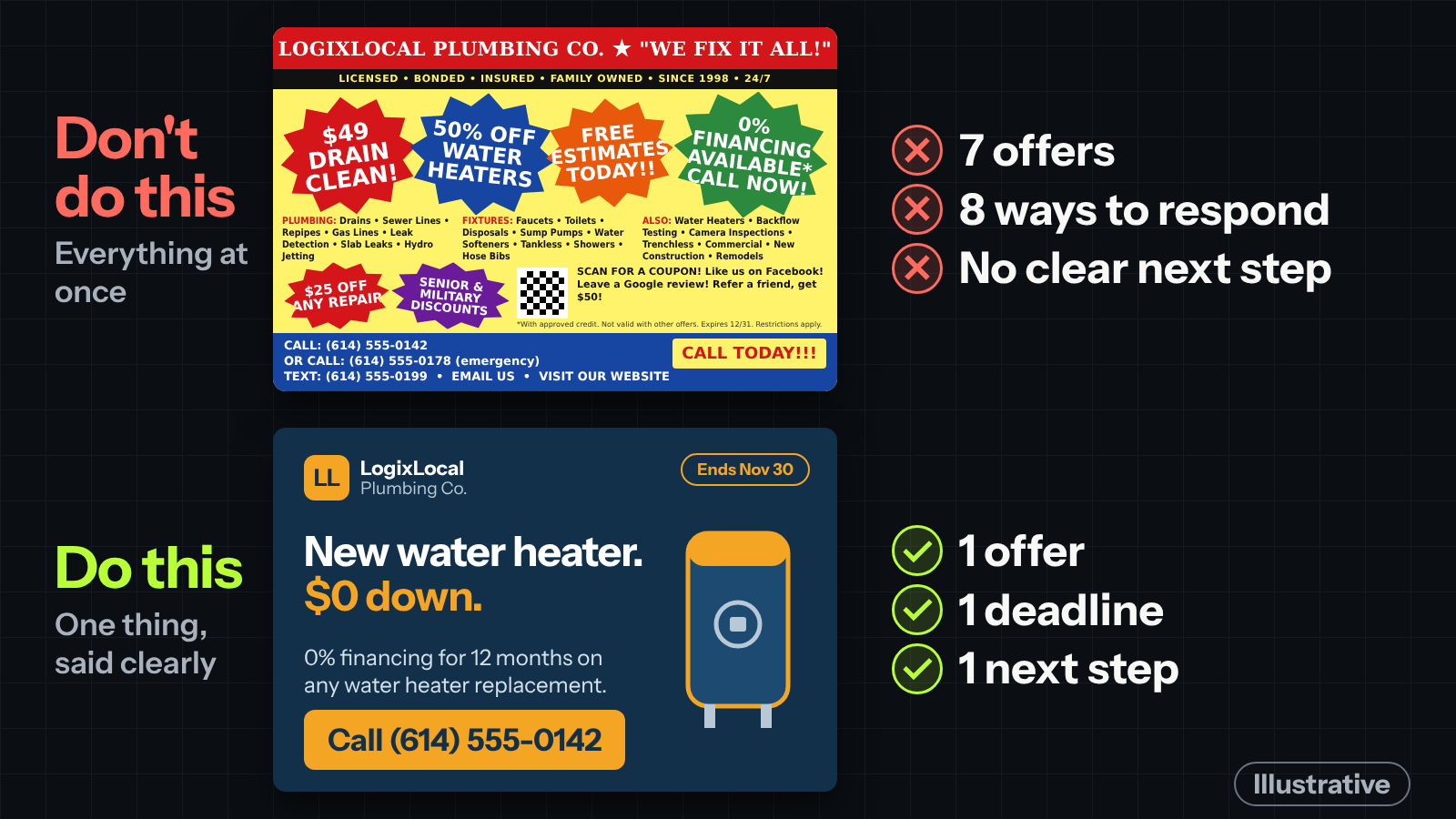
Most home-service mailers say the same thing: quality work, fair prices, family owned, call today. Remember when the Yellow Pages (the big phone book) landed on every porch and every plumber’s ad looked identical? A postcard like that has the same problem. Nobody can tell you apart, so nobody calls.
A mailer that books appointments does three things:
- Makes one offer. A free inspection, a free estimate or a seasonal tune-up. Pick one. Two offers split attention.
- Gives a reason to act now. A real deadline or a real limit, such as “through the end of the month” or “this neighborhood only.” Never invent urgency.
- Asks for one action. One phone number, large, and one QR code or short web address to a page that matches the card.
Put the offer and the number where the eye lands first. If someone has to hunt for how to reach you, you lose them.
Track every drop, or you are guessing
Tracking mail is not hard, but it only works if you set it up before the drop goes out. Use at least three of these:
- A unique phone number per drop. Use a call tracking number that forwards to your main line. Each drop or each list gets its own.
- A dedicated web address or QR code. Send it to a page that repeats the offer. Give each drop its own address so you can tell them apart.
- An offer code. Something short a person can say on the phone. It catches people who call your main number.
- A “how did you hear about us?” question. Your call takers should ask it every time and record the answer in the CRM, using the same list of choices.
- An address match. After the drop, compare the addresses of new appointments against the addresses you mailed.
Keep a simple log with one row per drop:
| Field | Why it matters |
|---|---|
| Drop date and list name | Lets you compare lists, not just drops. |
| Pieces mailed and total cost | The cost side of every calculation. |
| Tracking number and web address | Ties calls and visits back to the drop. |
| Calls, forms and scans | Your responses. |
| Appointments | Your converted leads. |
| Closed jobs | Needed for cost per closed job. |
Mail that lands today can still produce a call two weeks from now, so keep counting for a few weeks before you judge a drop.
The math, with illustrative numbers
These numbers are made up to show the method. They are not benchmarks, so swap in your own.
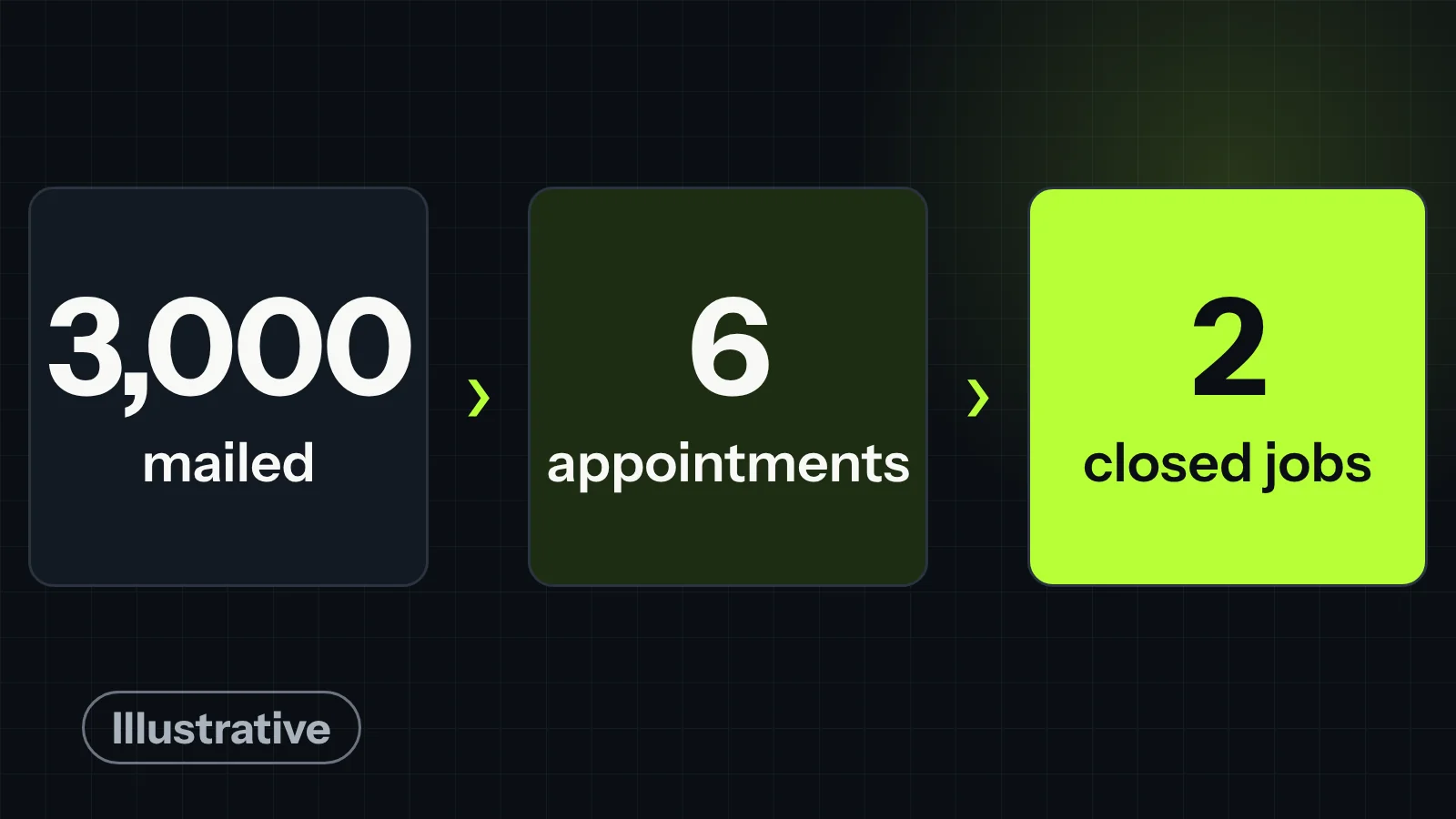
Say you mail 3,000 pieces. Postage is $0.26 each, and we will assume design and printing add $0.30 each. That is $0.56 per piece, or $1,680 for the drop.
| Weak list | Strong list | |
|---|---|---|
| Pieces mailed | 3,000 | 3,000 |
| Total cost (illustrative) | $1,680 | $1,680 |
| Response rate (illustrative) | 0.4% (12 responses) | 0.8% (24 responses) |
| Appointments, at 50% of responses (illustrative) | 6 | 12 |
| Cost per appointment | $280 | $140 |
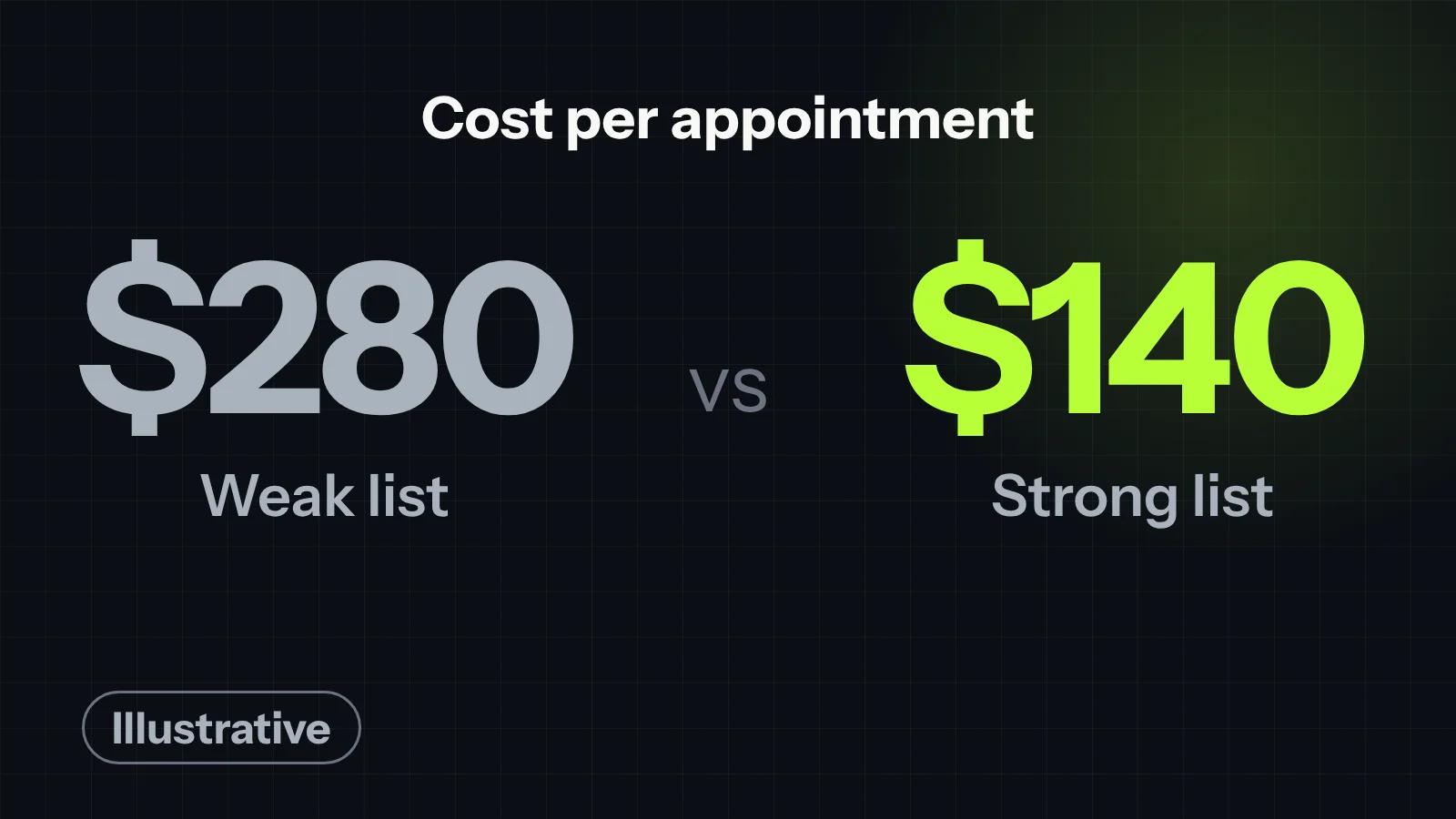
Same postcard, same cost, half the price per appointment. That is the list at work.
Now take it one step further. If 2 of the 6 appointments from the weak list close, the drop cost $840 per closed job. Whether that is good depends on what a closed job is worth to you. If you do not know your own cost per closed job yet, that is the first thing to fix.
Test small, then repeat
One drop tells you very little. A snowstorm, a competitor’s sale or a slow week can swing the result either way. A simple plan:
- Start with a small drop to one list, as small as 200 pieces for EDDM Retail.
- Change one thing at a time: the list, the offer or the design, never all three.
- Mail the same routes more than once before you decide. People often ignore a card the first time.
- Leave a few comparable routes unmailed, so you can see what your call volume does without the mail.
Scale only the lists that beat your target cost per appointment and, once you have the data, your target cost per closed job.

Field note
A client wanted to cram eight service offerings, two discounts, and their company backstory onto a 4×6 card. A mailer isn’t a website menu; it’s an invitation. Sticking to one hero offer produced double the appointments with half the clutter.
What we would check first in your account
- Whether past customers have been mailed at all, and what that drop produced.
- Whether each recent drop had its own tracking number and web address.
- Whether call takers record “how did you hear about us?” the same way every time.
- Whether appointments and closed jobs can be traced back to a drop.
- What each drop cost per appointment compared with your other sources.
Want help setting this up? See our direct mail and call tracking work.


