


Short version: Most open estimates aren’t a “no.” They are a busy homeowner who hasn’t decided yet. A simple two-week follow-up sequence, five touches mixing calls, texts and email, each with a real reason to reach out, closes more of the quotes you already paid to get. Let automation send the reminders, let your salesperson make the calls, and stop the moment the job is won or lost.
Plain definitions
- Open estimate: a quote you’ve delivered that the homeowner hasn’t accepted or declined.
- Close rate: closed jobs divided by estimates or appointments run.
- Follow-up sequence: a planned series of calls, texts and emails sent on set days after an estimate.
- Converted lead: a lead that turned into an appointment.
An open estimate is like a 90s Tamagotchi, the little egg-shaped digital pet: ignore it for a few days and it quietly dies. Nobody decides to let it go. Everyone just gets busy.
You already paid for the lead, the appointment and the salesperson’s time. Follow-up is the cheapest part of the process, and it’s the part most often skipped.
Quiet doesn’t mean no
Homeowners go quiet after an estimate for ordinary reasons:
- They need to talk it over with a spouse or partner.
- They’re waiting on financing, insurance or a tax refund.
- They’re comparing two or three quotes.
- They meant to call back and life got in the way.
Every one of those is still an open door. The company that follows up well, without being pushy, is usually the one still in the conversation when they decide.
The two-week sequence
| Day | Channel | Purpose |
|---|---|---|
| Day 0 | Text and email | Thank them, send the estimate, name who to call with questions. |
| Day 2 | Call from the salesperson | Answer questions. Ask what else they need to decide. |
| Day 5 | Send something useful: photos of their problem, financing options or reviews from nearby jobs. | |
| Day 9 | Call, then text if no answer | Ask whether timing, budget or another quote is the holdup. Offer schedule options. |
| Day 14 | Text | Close the loop: should you keep the estimate open or close it out? |
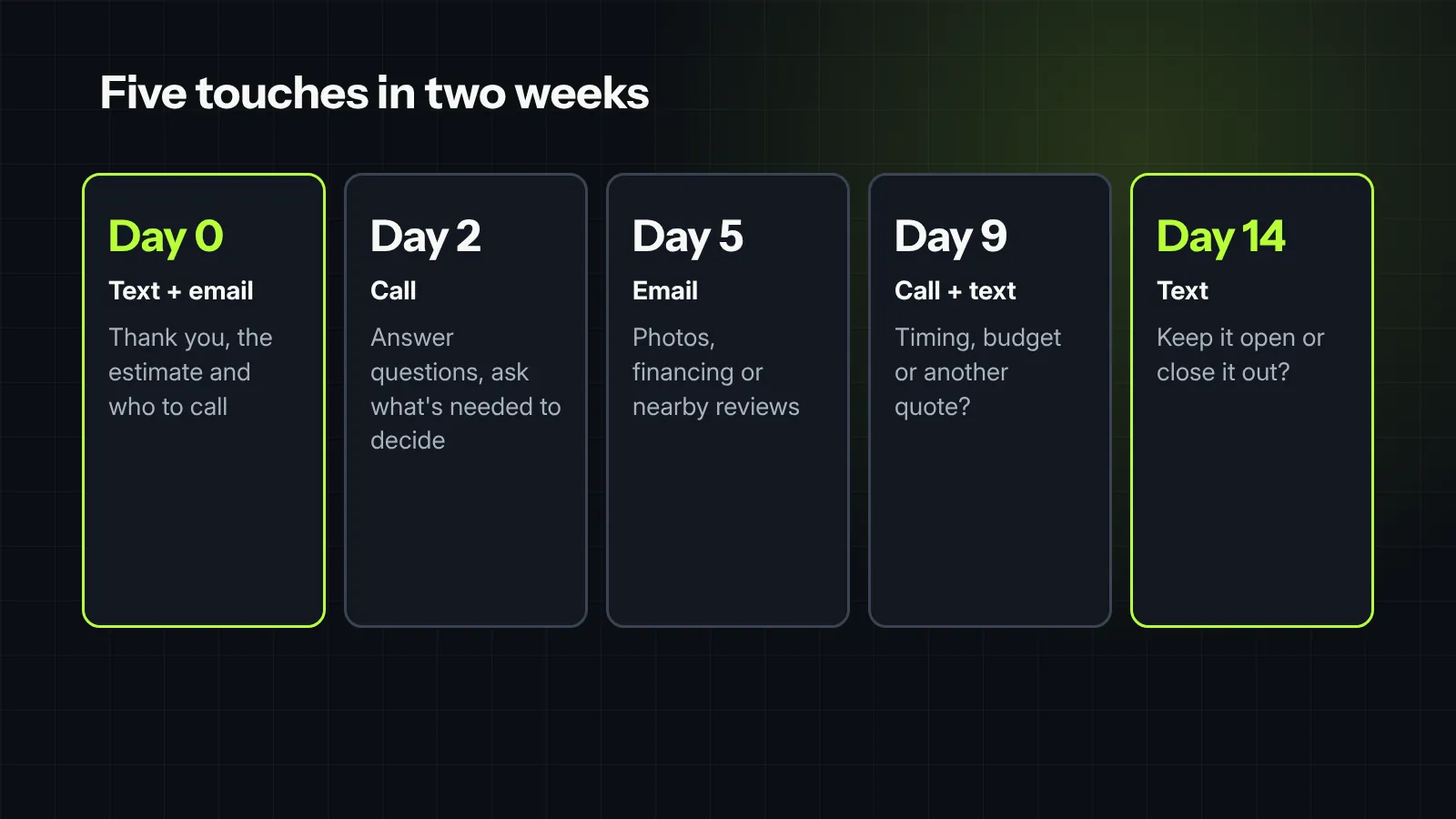
Five touches in two weeks. Every one has a reason beyond “just checking in.”
What to say at each step
Day 0, same day:
Hi Sarah, thanks for having us out today. Here’s your estimate for the roof repair: [link]. I’m the one to call with any questions, at this number. – Dana, Example Roofing
Day 9, if they don’t pick up:
Hi Sarah, Dana from Example Roofing. Just tried you. Is it timing, budget or something else holding things up? Happy to work around your schedule.
Day 14, the close-the-loop text:
Hi Sarah, I don’t want to keep bugging you. Should I keep your estimate open, or close it out for now? Either answer is totally fine.
That last message gets replies when nothing else does. It gives people an easy, polite way to answer, and plenty of them answer “keep it open, we’re ready next month.”
Handle the three most common holdups
Most stalled estimates come down to one of three things. Your follow-up should give each one an easy answer.
- Price. Don’t cut it right away. Explain what’s included, show options at different levels, and mention financing if you offer it. “Would it help to see a good, better and best version?” keeps the conversation open.
- Timing. Offer to put them on the schedule for a later date. A booked job in six weeks beats a “maybe” today.
- Another quote. Ask what they’re comparing. Often it isn’t the same scope of work. Explaining the difference, without trashing the competitor, wins more than matching the price.
Personal, without extra work
Automated doesn’t have to mean generic. Most CRMs and texting tools can fill in details for you:
- The homeowner’s first name and the salesperson’s name.
- The type of job and the estimate amount.
- A photo from the visit, like the cracked shingle or the corroded pipe.
A message with their name, their problem and a photo of their house reads like a person wrote it. Because, in a way, one did.
Who does what
- The salesperson makes the calls. They met the homeowner and know the job. A call from them lands better than one from the office.
- Automation sends the texts and emails. On schedule, every time, without anyone needing to remember.
- The CRM stops the sequence. The moment the estimate is marked won or lost, every scheduled message stops. Thanking someone for considering you, after they’ve already signed, is how follow-up gets embarrassing.
What not to do
- Don’t lead with a discount. Dropping the price on day 3 teaches customers to wait you out. If you offer anything, make it scheduling priority or a financing option.
- Don’t text every day. Five touches over two weeks is persistent. Ten is a nuisance.
- Don’t send generic check-ins. “Just following up!” gives them nothing to respond to. Ask a question.
- Don’t ignore opt-outs. If someone replies STOP, the sequence ends, and the opt-out is honored. The rules are covered in missed-call text-back: what to say.
What a few extra closes are worth
These numbers are made up to show the method. Swap in your own.
| Before the sequence | With the sequence | |
|---|---|---|
| Estimates delivered in a month (illustrative) | 100 | 100 |
| Close rate | 30% | 35% |
| Closed jobs | 30 | 35 |
| Revenue at a $9,000 average ticket | $270,000 | $315,000 |
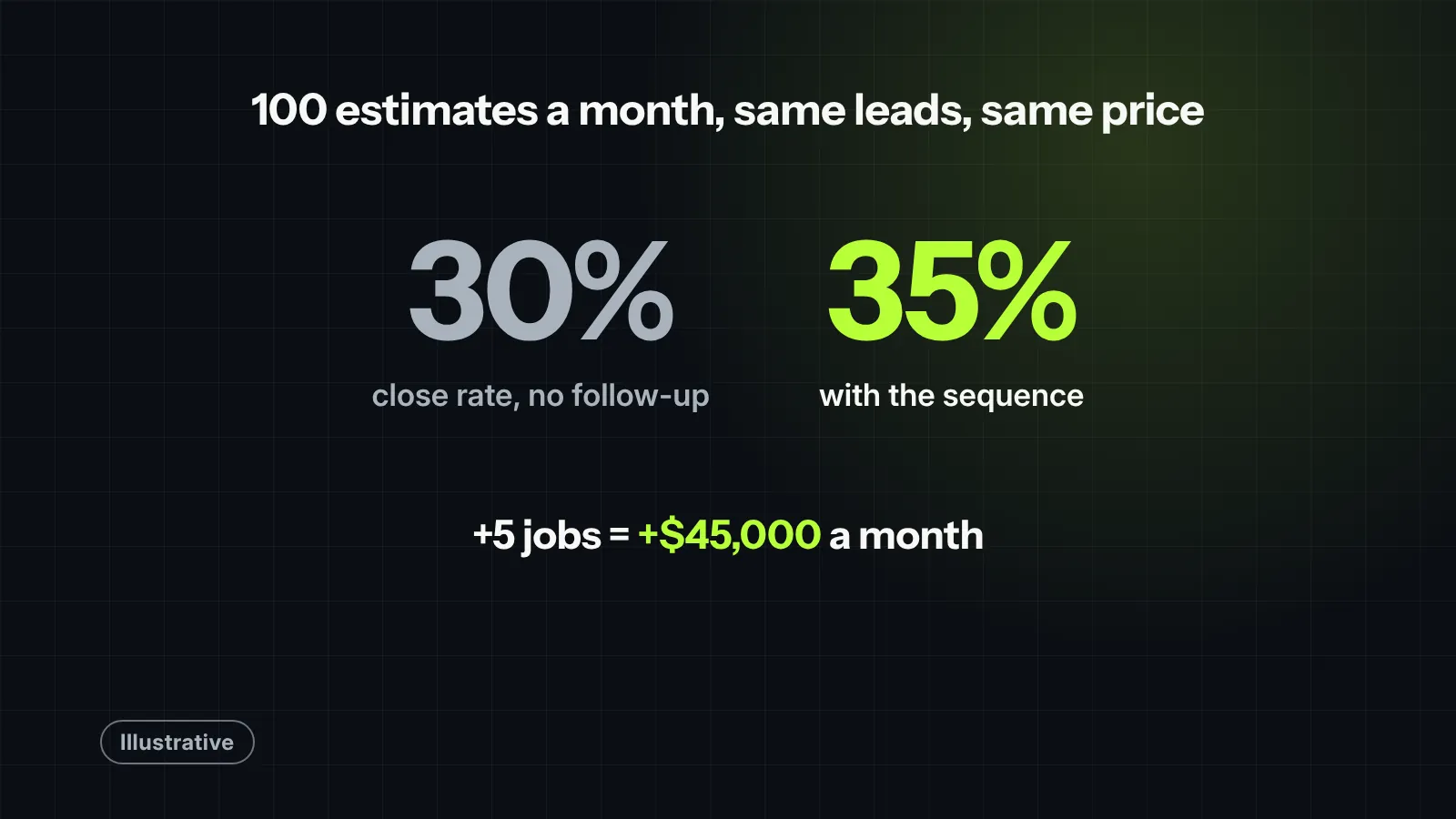
Five points of close rate is $45,000 a month in this example, with no extra marketing spend. That is why follow-up is usually the first thing we fix.
Track the sequence, not just the sales
- Close rate on estimates, month over month, by salesperson.
- Days from estimate to signed, to see whether follow-up shortens the wait.
- Which step got the reply. If the day-14 text wins most of them, that tells you something about the earlier steps.
- Opt-outs. A rising opt-out rate means the messages are too frequent or too generic.
After two weeks: keep a slow drip going
An estimate that’s still open after two weeks isn’t dead. Move it to a slower track: a check-in every month or two, plus seasonal reminders. Some of your best jobs will come from estimates people sat on for six months.
Once a quote is closed out as lost, the homeowner joins your past-contact list. That list is covered in reactivating past customers.

Field note
Most contractors stop following up after the initial call or quote goes unanswered. We worked with an estimator team that averaged just 1.2 contact attempts per unbooked lead before writing them off as dead. When we implemented a structured five-step follow-up cadence combining calls and SMS over two weeks, their close rate jumped by 18% in the first month without spending an extra dollar on marketing. Over half of those newly booked jobs came on the second or third touch, proving that most unbooked leads aren’t lost to competitors: they’re just waiting on someone to follow through.
What we would check first in your account
- How many estimates are open right now, and how old they are.
- What happens after an estimate is delivered today, step by step, and who owns it.
- Whether follow-up stops automatically when an estimate is marked won or lost.
- Close rate on estimates for the last two quarters, by salesperson and lead source.
- How many lost estimates ever hear from you again.
Want help building the sequence? See our follow-up and nurture work.


